
Kecak Fire Dance Uluwatu 2026: Tickets, Show Times and How to Get a Good Seat
Kecak tickets cost IDR 150,000 and the temple entry on top is IDR 60,000. Two shows nightly, seats are first come first served, and the good ones go before 5pm.
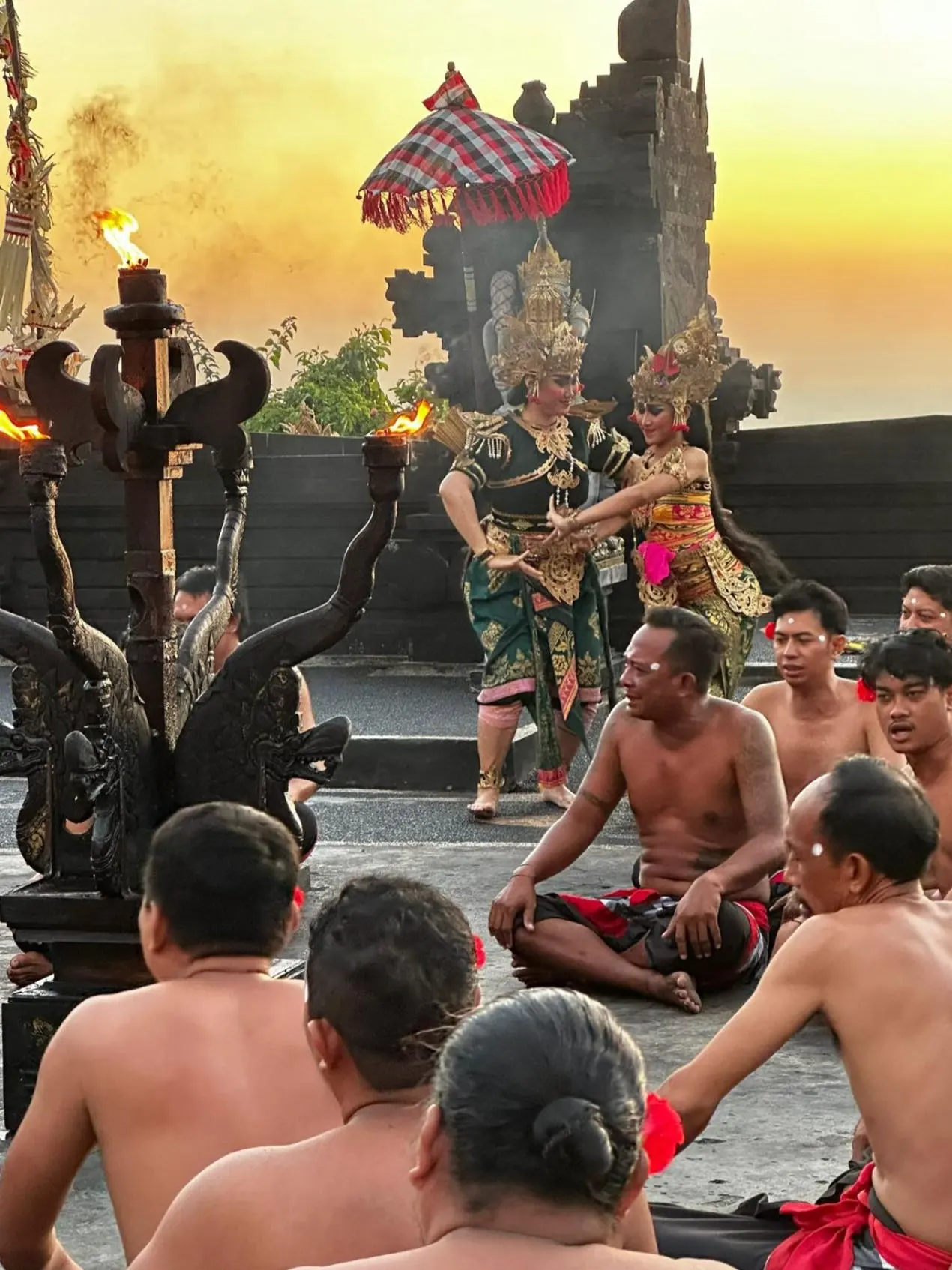
The first time I went, I turned up at ten to six with a ticket I had bought at the gate and ended up on a stone step at the back, behind a man filming the entire hour on an iPad. The dance was still extraordinary. I just could not see much of it.
The second time I got there at twenty past four, paid for both tickets separately, sat six rows up in the middle, and watched the sun drop into the Indian Ocean while seventy men chanted in the dark. That is the version worth having, and the difference between the two evenings came down to about ninety minutes of planning.
This guide covers what the Kecak fire dance actually costs in 2026, which of the two nightly shows to book, how the seating really works, and the practical things that catch people out at Uluwatu. There is one fee almost nobody budgets for, and one very real hazard involving monkeys.
What the Kecak Fire Dance Actually Is
Kecak is a circle of men, usually between fifty and seventy of them, chanting a rhythmic “chak-chak-chak” with no instruments of any kind. No gamelan, no drums, nothing. The human voice does all of it, and the sound is stranger and more physical than any recording prepares you for.
Inside that circle, dancers perform a section of the Ramayana: Rama, his wife Sita, her abduction by the demon king Ravana, and the rescue led by Hanuman the monkey general. The finale is the fire dance, where a performer in a horse costume kicks through a pile of burning coconut husks, barefoot.
It is worth being straight about the history, because plenty of guides are not. Kecak in the form you will watch is not ancient. It was developed in the 1930s, shaped partly by the German artist Walter Spies working with Balinese dancers, drawing the chanting from a much older trance ritual called sanghyang. The trance ritual is genuinely old. The performance built around it was made for audiences.
That does not make it fake, and I would push back on anyone who says it does. The chanting, the choreography and the musicians are all Balinese, the performers are drawn from local villages, and the standard is high. It is simply theatre rather than ceremony, and knowing that beforehand tends to make people enjoy it more rather than less.
Kecak Tickets and the Fee Everyone Forgets
Here is the part that trips people up at the gate. There are two separate tickets, and the Kecak ticket does not include temple entry.
| What | Adult | Child |
|---|---|---|
| Uluwatu Temple entry | IDR 60,000 | IDR 40,000 (ages 4 to 12) |
| Kecak fire dance | IDR 150,000 (ages 10+) | IDR 75,000 (ages 2 to 9) |
| Total per adult | IDR 210,000 |
So budget about IDR 210,000 a head, roughly £10 to £11, not the IDR 150,000 you will see quoted almost everywhere. For a couple that is IDR 420,000. It is still very good value for an hour of live performance on a clifftop, but it is worth knowing before you are standing at a ticket window counting notes.
Booking online in advance is usually a few thousand rupiah cheaper on the dance ticket, and some platforms list adult tickets from around IDR 140,000. The saving is trivial. The reason to book ahead is that the Kecak regularly sells out, often by around 5pm, and in July, August and over Christmas and New Year it can go earlier than that. If you are travelling in peak season, book two or three days out and stop thinking about it.
You will still pay temple entry separately on arrival, whichever way you buy the dance ticket.
Ignore anyone selling tickets to you in the car park. The official windows are at the temple entrance, and the touts outside are marking up a ticket you can buy yourself in five minutes.
Two Shows a Night: Which One to Book
There are two performances every evening, at 6pm and 7pm, and each runs for about 60 minutes. Not 90, whatever you may have read. An hour.
They are not the same experience.
The 6pm show is the one timed to sunset. Bali sunsets sit somewhere between about 5.50pm and 6.35pm depending on the month, so for most of the year the sun goes down partway through the performance, behind the dancers and over the ocean. This is the show people photograph, and it is the one I would book first.
The 7pm show happens in full darkness. You lose the sunset entirely, but the firelight does much more work, and the final fire dance is genuinely more dramatic against a black sky. It is also usually the quieter of the two. If the 6pm has sold out, this is not a consolation prize.
If you only get one shot at it and the weather forecast is clear, take 6pm. If it is overcast, the sunset is not going to deliver anyway and 7pm is the better ticket.
Performances do occasionally get cancelled for religious ceremonies at the temple. It is uncommon, but it is a reason not to build your last night in Bali entirely around it.
Getting a Seat Actually Worth Sitting In
The amphitheatre is an open stone semicircle on the cliff edge, and seating is first come, first served. Your ticket does not have a seat number on it. This is the single thing that most determines whether you enjoy the evening.
The honest timings:
- Before 4.30pm: you can sit wherever you like.
- Around 5pm: still fine, you will get something decent in the middle.
- 5.30pm onwards: you are choosing between what is left.
- Arriving at 5.55pm for the 6pm show: back rows, restricted views, someone’s phone in your eyeline.
For the 6pm show I would be seated by 5pm at the latest. That sounds excessive for a performance that starts at six. It is not, and the hour is not wasted, because the temple itself is worth walking before you sit down.
On where to sit: the middle section, around five to eight rows up is the sweet spot. You are high enough to see the whole circle of chanters rather than just the backs of the front row, and central enough that the fire finale happens in front of you rather than off to one side. The top rows give you the best panoramic shot of the circle with the ocean behind it, which is what you want if photography is the priority, though you lose some of the detail on the dancers’ faces.
The seating is stone and it is not padded. An hour on it is fine but noticeable. A folded sarong makes a real difference and you will probably be carrying one anyway.
The Monkeys Are a Genuine Problem
This is not a charming detail to mention in passing. The macaques at Uluwatu are organised, experienced thieves, and they specifically target sunglasses, phones, hats and loose jewellery. They have worked out that people trade food for returned property, and some of them are very good at it.
What actually works:
- Take sunglasses off your head and put them in a zipped bag before you walk in.
- Do not carry food or drink in an open bag.
- Keep your phone in your hand or a zipped pocket, not a back pocket or a loose sling.
- If one does take something, do not chase it or try to grab it back. Temple staff deal with this constantly and will usually sort it out with a piece of fruit.
- Do not make eye contact and do not provoke them for a photograph.
I have watched a man lose prescription glasses in about two seconds flat, and the monkey sat on a wall directly above him and chewed on them. Take it seriously and it is a non-event. Ignore it and it can cost you your holiday sunglasses.
Getting There from Wherever You Are Staying
Uluwatu Temple sits on the Bukit Peninsula at the southern tip of the island, and the drive is longer than the map suggests because of Bali’s traffic.
| From | Rough drive time |
|---|---|
| Jimbaran | 30 to 40 minutes |
| Seminyak | 1 hour to 1 hour 15 |
| Canggu | 1 hour 15 to 1 hour 45 |
| Ubud | 1 hour 45 to 2 hours 15 |
Those are evening estimates, and they assume the usual southern gridlock. Leave more time than you think, particularly from Canggu, where the traffic is now genuinely unpredictable.
A private driver for the evening is the sensible option and generally runs IDR 400,000 to 700,000 for a return trip with waiting time, which splits well between three or four people. Ride-hailing apps work for getting there but can be awkward for the return leg, because several hundred people leave the same car park at the same moment. If you scooter down, the car park is large but chaotic after the show.
For more on that choice generally, my guide to getting around Bali by scooter or private driver goes through the trade-offs properly.
Make an evening of it rather than driving two hours for an hour of dance. There are good seafood places on the beach at Jimbaran on the way back, and if you are down that way in daylight, Suka Espresso in Uluwatu is worth the stop.
What to Wear and What to Bring
You are entering an active Hindu temple, so shoulders and knees covered is the rule for everyone. A sarong and sash are provided free at the entrance and staff will hand you one if you need it, so do not let anyone sell you one in the car park.
Beyond that:
- A light layer. It is a clifftop, it is open to the sea, and once the sun goes it gets properly breezy.
- Shoes you can walk in. The temple paths and the amphitheatre steps are uneven stone.
- Water. Food and drink options at the temple are limited, so eat before or after.
- A folded sarong to sit on, as above.
Photography is allowed throughout and phones are fine. Flash is not, and it genuinely ruins the fire finale for everyone around you. Nobody is going to stop you filming the whole hour, but I would gently suggest watching it instead.
Is the Kecak Fire Dance Worth It?
Yes, with one qualification.
It is worth it if you arrive early enough to get a decent seat and to walk the temple in daylight first. The setting does an enormous amount of the work here: a clifftop temple, the Indian Ocean two hundred feet below, seventy voices and no instruments, and a fire finale in the dark. At around IDR 210,000 all in, for an hour of that, it is one of the better value things you can do in Bali.
It is not worth it if you turn up at five to six, sit at the back behind someone’s tablet, and leave in the car park scrum wondering what the fuss was about. That is the same show and a completely different evening.
If you want more of Bali’s temples once you have done this one, the best temples in Bali covers which are genuinely worth your time and which are better skipped.
FAQs
How much are Kecak dance tickets at Uluwatu in 2026?
The dance ticket is IDR 150,000 for adults aged 10 and over, and IDR 75,000 for children aged 2 to 9. Uluwatu Temple entry is charged separately at IDR 60,000 for adults and IDR 40,000 for children aged 4 to 12, so budget around IDR 210,000 per adult in total.
What time is the Kecak fire dance at Uluwatu Temple?
There are two performances nightly, at 6pm and 7pm, and each lasts about 60 minutes. The 6pm show is timed to coincide with sunset. The 7pm show takes place in full darkness, which suits the fire finale.
Do I need to book Kecak tickets in advance?
In peak season, yes. Tickets frequently sell out by around 5pm, and July, August and the Christmas to New Year period can go earlier. Booking two or three days ahead online is worth it. Outside peak season you can usually buy at the gate, but arrive early regardless because seating is first come, first served.
How long is the Kecak fire dance?
About 60 minutes. Allow two to three hours in total for arriving, walking the temple grounds, securing a seat and the performance itself.
What time should I arrive for the 6pm Kecak show?
Be seated by 5pm for a good seat, and earlier still in high season. Arriving at 4.30pm gives you your pick of the amphitheatre plus time to walk the temple in daylight.
Where are the best seats at the Kecak amphitheatre?
The middle section, roughly five to eight rows up, gives the best balance of view and detail. The top rows are better for panoramic photographs of the full circle with the ocean behind it. Seating is unreserved, so position comes down to arrival time.
Is the Kecak dance at Uluwatu authentic?
The chanting derives from sanghyang, a genuine Balinese trance ritual, but the performance as staged today was developed in the 1930s for audiences. The performers, the choreography and the tradition behind it are all Balinese. It is theatre rather than ceremony, and it is performed to a high standard.
Are the monkeys at Uluwatu Temple a problem?
They can be. The macaques there routinely take sunglasses, phones, hats and loose items, and they are practised at it. Stow sunglasses before you enter, keep your phone secure, carry no visible food, and do not attempt to retrieve anything yourself. Temple staff handle it regularly.
What should I wear to the Kecak fire dance?
Shoulders and knees must be covered for temple entry. A sarong and sash are provided free at the entrance. Bring a light layer for the sea breeze after sunset and wear shoes suitable for uneven stone steps.
How far is Uluwatu Temple from Canggu or Ubud?
Allow 1 hour 15 to 1 hour 45 from Canggu and around 2 hours from Ubud in evening traffic. From Seminyak it is about an hour, and from Jimbaran 30 to 40 minutes. Leave more time than the map suggests.
Disclaimer
Cultural & Entertainment Events: This article describes my own experience attending the Kecak fire dance at Uluwatu Temple. Fire performances carry inherent risks. Always follow venue safety instructions.
Destined for Bali shares my personal experiences and independent research. Everything I write reflects what I have found to be true at the time of publishing, but performance schedules, prices and temple protocols change. Ticket prices and show times were verified in September 2026. Always confirm current information directly with Uluwatu Temple or your booking operator before attending.
Some links in my posts are affiliate links, meaning I may earn a small commission at no extra cost to you. Sponsored content is always clearly labelled. Read the full Terms and Privacy Policy.


